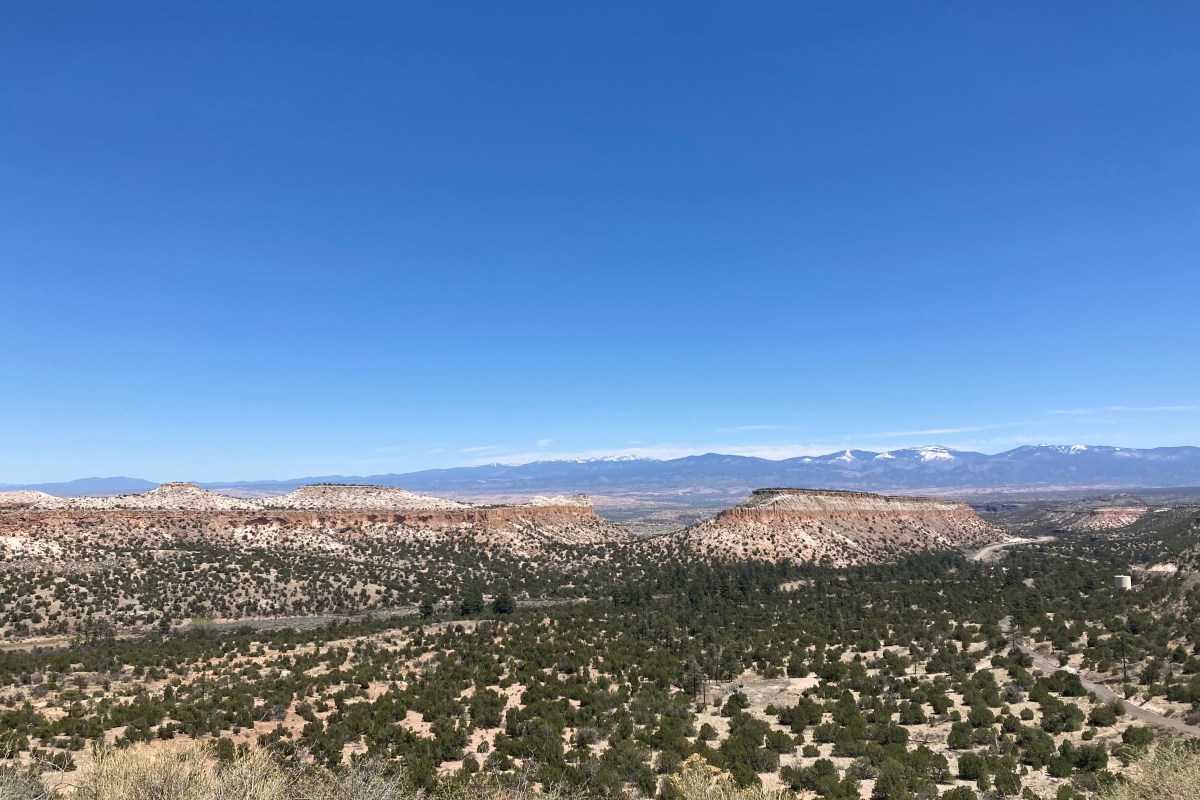
Pictures just don’t do the scenery justice. Above is the best I could do, a few miles outside Los Alamos.
But first I went to Taos and Taos Pueblo. I found the countryside around Taos beautiful, but not being in the market for art or jewelry, the town didn’t have much to offer me.
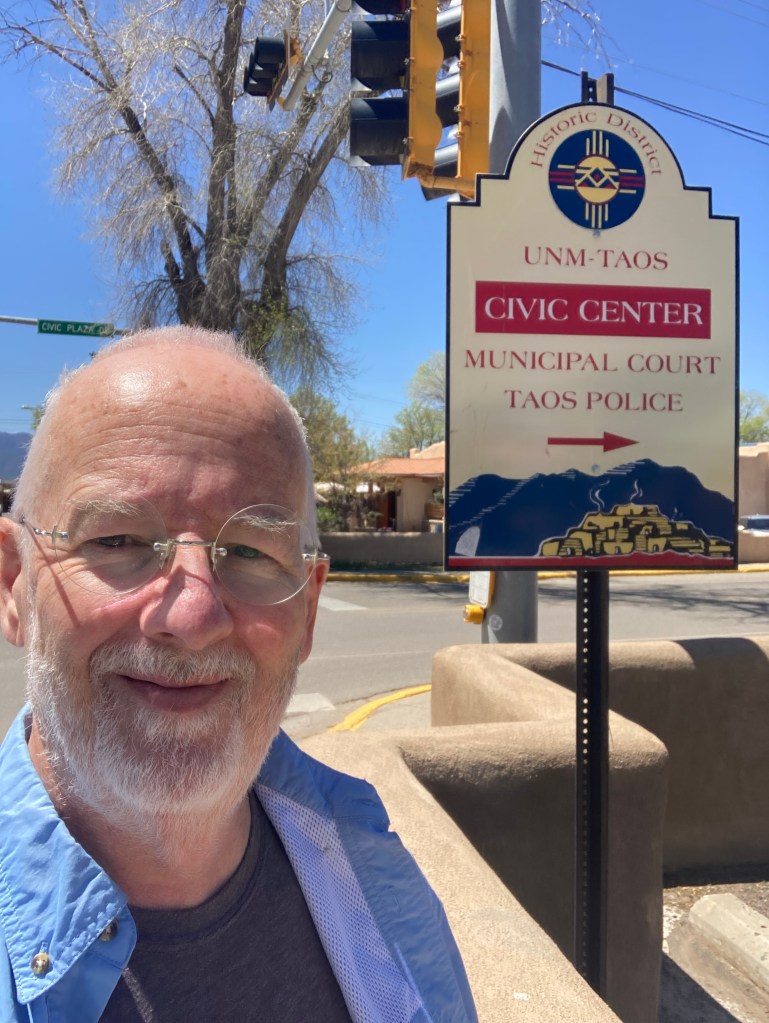
Taos Pueblo gave me much on which to think. Start with history, environmental and political. While the Puebloan people are believed to have been in the area from about 900 CE, the original pueblo is thought to have been built circa 1325 by a population displace by drought in the Four Corners area. The current pueblo is dated to about 1400, making it the oldest continuously inhabited community in the United States.
I originally typed “occupied” rather than inhabited. But the occupation occurred in 1540 with the arrival of the conquistadors and the Jesuits. Taos Pueblo revolted in 1640, and in 1660 was part of the Pueblo Revolt, the only successful effort to oust the Spanish from the territory. Temporarily. The Spanish reconquered the area twelve years later. Then Teddy Roosevelt seized their sacred mountain for Carson National Forest. My good friend Richard Nixon gave it back.
There are reported to be about 150 people living in the Pueblo today. Through my Eastern/Urban lens, it appears to be subsistence living and in need of “improvement”. I have become increasingly skeptical of that lens for myself. Trying to apply it to others seems, at best, dubious. Reinforcing my concerns are local media reports regarding frustration with federal efforts to support recovery from last year’s fires, floods, and debris flows. Prior to those events, many people in the area lived in self-built homes without electricity, running water, or central heat. Also without debt and with the ability to control their interactions with their community and with no connection to a federal government that many do not trust.
When federal taxpayer dollars are spent, the expectation is that new construction will be safe, sanitary, and resilient to future threats. That means running water with well depths in the mountains running to 1,000 feet, septic systems in difficult terrain, grid power that must be run long distances, and central heat. All of which come with government strings and long term debt. And if you don’t like that, the alternative is to move to what amounts to a trailer park for up to 18 months of temporary housing. The requirements are with the best of intentions for the survivors and for the prudent use of tax dollars. But it is easy to see why many think of it not as a bad deal, but no deal at all. Back to where I started, maybe I have the wrong impression of life on the Pueblo. Or maybe not. I don’t know. I do know that it reinvigorates my belief in a Universal Basic Income. Then people can do as they choose.

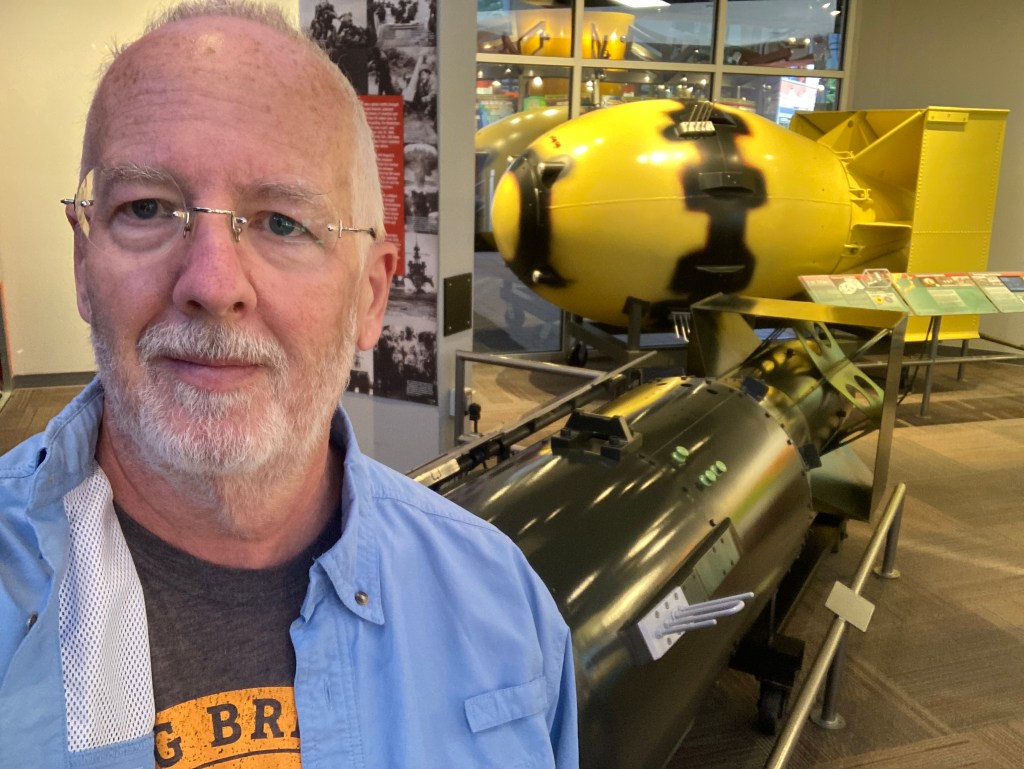
All of which makes my visit to Los Alamos anti-climactic. I went, I saw Bathtub Row, Hans Bethe’s house, and got to pose with models of Fat Man and Little Boy. I really wanted to buy a Los Alamos hat, but then was concerned about what I might be promoting. Back in the car and back to Santa Fe to end an all around ambivalent day.
 The Journey